




How and to What Extent Is the EU Investing in the Modernization of Serbia’s Railways?
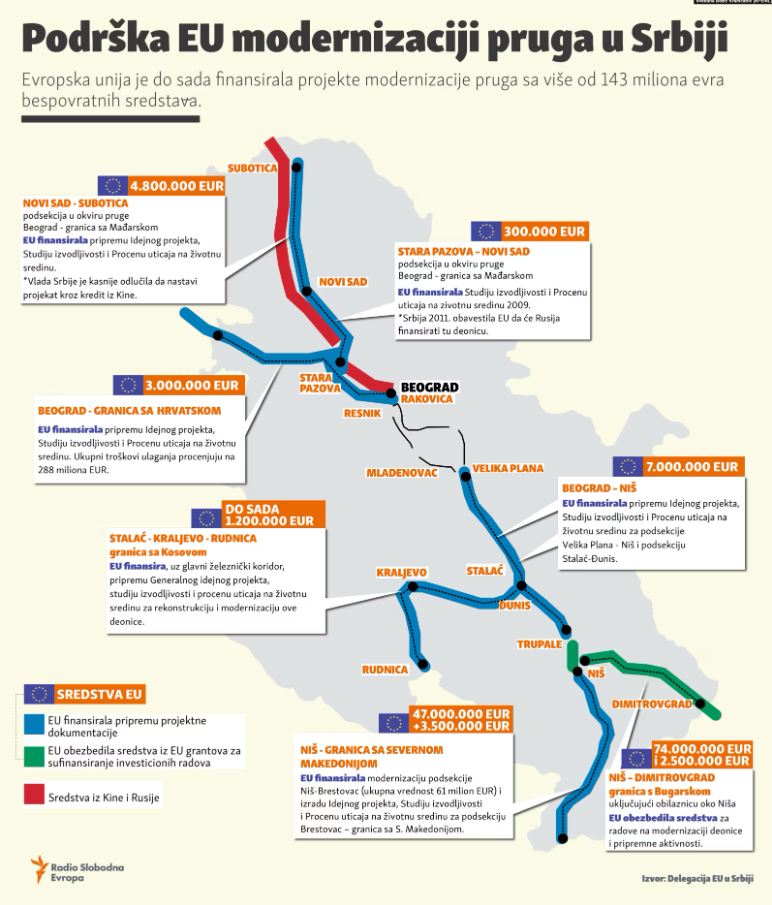
In the past 11 years, the European Union (EU) has financed various projects for the modernization of Serbia’s railways with over €143 million in grants, according to data provided to Radio Slobodna Evropa (RSE) by the EU Delegation to Serbia.
When discussing railway modernization in Serbia, government officials and the relevant Ministry often highlight projects with China and Russia.
Serbia modernizes its railways through numerous loans from these two countries. This year alone, Serbia’s projected loans from Russia, according to the 2020 budget plan, amount to €1.73 billion, a figure that increases annually.
However, it is less known that the EU, through its grants, is involved in numerous railway modernization projects in Serbia. Some of these sections include those for which Serbia subsequently took loans from China and Russia.
Grants and Favorable Loans
The EU is involved in financing the modernization of five key railway sections in Serbia that are part of the Pan-European Corridor 10. EU investments are reflected through the preparation of project-technical documentation necessary for the start of works and by providing grants (EU grants) for co-financing. Additionally, Serbia has access to loans from the European Investment Bank (EIB) and the European Bank for Reconstruction and Development (EBRD) under favorable conditions.
The European Investment Bank, as the EU’s bank and a non-profit organization, offers Serbia the most favorable loans, without mandatory fees, management fees, or any other charges, according to the EU Delegation to Serbia.
Belgrade to the Hungarian Border Section
In the modernization of the railway section from Belgrade to the Hungarian border, the EU financed the Feasibility Study and Environmental Impact Assessment for the subsection Stara Pazova–Novi Sad as early as 2009. That year, the Serbian government contacted the EU, requesting financial support for the Feasibility Study.
The European Investment Bank was initially envisaged as the financier for the modernization of this subsection. The Feasibility Study was prepared in 2009. However, negotiations were not realized as Serbia informed the EIB in 2011 that the loan for that section would be provided by Russia.
Funds for the Feasibility Study, provided by the EU, were financed through a technical assistance project, with a budget of approximately €300,000 allocated by the EU for the study.
The total length of the Stara Pazova–Novi Sad section is 41 kilometers, and the Feasibility Study determined the total project value to be €368 million.
On the same section, on the railway line from Belgrade to the Hungarian border, the Serbian government requested the EU to finance the preparation of project-technical documentation for the Novi Sad–Subotica subsection.
Specifically, at the request of the Serbian government, the EU provided funding of nearly €4.8 million for the preparation of a preliminary design, feasibility study, and environmental impact assessment.
The preparation of this documentation was carried out following the Terms of Reference prepared and approved by the relevant Serbian institutions, in this case, Serbian Railways Infrastructure and the Ministry of Construction, Transport, and Infrastructure. The documentation was prepared for a designed train speed of 160 kilometers per hour.
The preparation of the documentation began in June 2013 and lasted until July 2016. However, in this case as well, the Serbian government subsequently decided to continue the project with loans from China.
The total length of the railway from Novi Sad to Subotica is 113 kilometers, and the Feasibility Study and Cost-Benefit Analysis determined the modernization value of this railway section to be €495 million.
Belgrade to the Croatian Border Section
On the railway section from Belgrade to the Croatian border, the EU is currently financing the preparation of the preliminary design, feasibility study, and environmental impact assessment for a subsection 120 kilometers long. Specifically, this refers to the stretch from Belgrade to Šid, including two subsections: Stara Pazova–Golubinci and Golubinci–Inđija.
This project encompasses the entire stretch from Belgrade to the Croatian border, with EU grants amounting to €3 million approved for this initiative.
This project is also supported by the European Investment Bank as the leading international financial institution. Once the documentation is fully prepared, negotiations on the funding structure are expected to begin. It should be noted that this funding, in addition to EIB loans, also includes EU grants.
The total investment cost is currently estimated at €288 million, but more precise information on the total project costs will be available after the completion of the Feasibility Study, according to the EU Delegation to Serbia.
Belgrade–Niš Section
The railway section from Belgrade to Niš is considered the backbone of Serbia’s railway network. On this section, the EU is financing the preparation of a preliminary design, feasibility study, and environmental impact assessment for the subsections Velika Plana–Niš, 110 kilometers long, and Stalać–Đunis, approximately 20 kilometers long.
To date, Serbia has received €7 million in EU grants for these preparatory projects for the creation of the mentioned project-technical documentation.
The preparation of the Velika Plana–Niš subsection began in March 2017. The preparation of this project documentation is in its final phase and has been submitted to Serbian Railways Infrastructure for evaluation and comments.
As for the Stalać–Đunis subsection, its preparation began in 2015, and the documentation has already been approved by the relevant Serbian authorities.
The European Investment Bank and the European Bank for Reconstruction and Development are interested in investment financing for the Velika Plana–Niš section, which in this case would also include a significant amount of EU grants, according to the EU Delegation to Serbia. This amount accounts for up to 50% of the investment value for railway infrastructure modernization projects.
The total estimated investment value for this project is €565 million. The documentation prepared was designed for train speeds of 160 kilometers per hour, as specified in the Terms of Reference. This documentation has also been approved by Serbian Railways Infrastructure and the Ministry of Construction, Transport, and Infrastructure.
As for the Stalać–Đunis subsection, the project costs are estimated at €160 million. Besides the EIB, significant support from EU investment grants is also envisaged here.
Niš to the North Macedonian Border Section
The European Union has allocated €47 million in grants for the railway section from Niš to the North Macedonian border, specifically for financing the modernization of the Niš–Brestovac subsection, 23 kilometers long. Serbia, on the other hand, is expected to provide €14 million, the remaining amount needed to reach the total project value agreed upon at €61 million.
In December 2019, a contract for the works was signed between the Ministry of Finance and the Bulgarian company TRACE Balkan Limited. The technical documentation for the modernization of this subsection was prepared thanks to EU grants amounting to approximately €2.5 million.
For the subsection from Brestovac to the North Macedonian border, 135 kilometers long, the EU provided a grant for the preparation of a preliminary design, feasibility study, and environmental impact assessment amounting to €3.5 million.
Currently, a Feasibility Study is underway, after which the total investment value will be determined. The current estimate of €182 million may increase after revisions, according to the EU Delegation.
Niš–Dimitrovgrad to the Bulgarian Border Section
The modernization of the Niš–Dimitrovgrad railway section, including the construction of a bypass around the city of Niš, is significantly supported by EU grants amounting to €74 million, as well as a €134 million EIB loan.
The remaining amount, up to the total project value of €268 million, will be co-financed through EU investment grants of approximately €30 million.
Despite the project being considered “mature,” no tenders for works have been issued since January 2018.
And That’s Not All
In addition to the main railway corridor through Serbia, the EU is also funding the preparation of the General Project, preliminary feasibility study, and environmental assessment for the reconstruction of the Stalać–Kraljevo–Rudnica railway line up to the Kosovo border.
The total cost is estimated at €265 million, with implementation planned for 2025. To date, €1.2 million has been allocated for feasibility studies and preliminary assessments.